11 September, 2026
We are delighted to announce that our group’s latest research on Salicornia, an edible plant that can be irrigated with seawater, has been published in Nature Communications. This work was carried out by Yunchuan Wang, co-first author of the study, whose dedication and expertise were central to bringing the project to completion.
Salicornia thrives on salt marshes, where conventional crops cannot survive. As agricultural land becomes increasingly saline and freshwater resources grow scarcer, salt-tolerant plants like Salicornia offer a promising path toward more resilient food production. Despite this potential, the genus has seen very little breeding, and its species have long been notoriously difficult to tell apart.
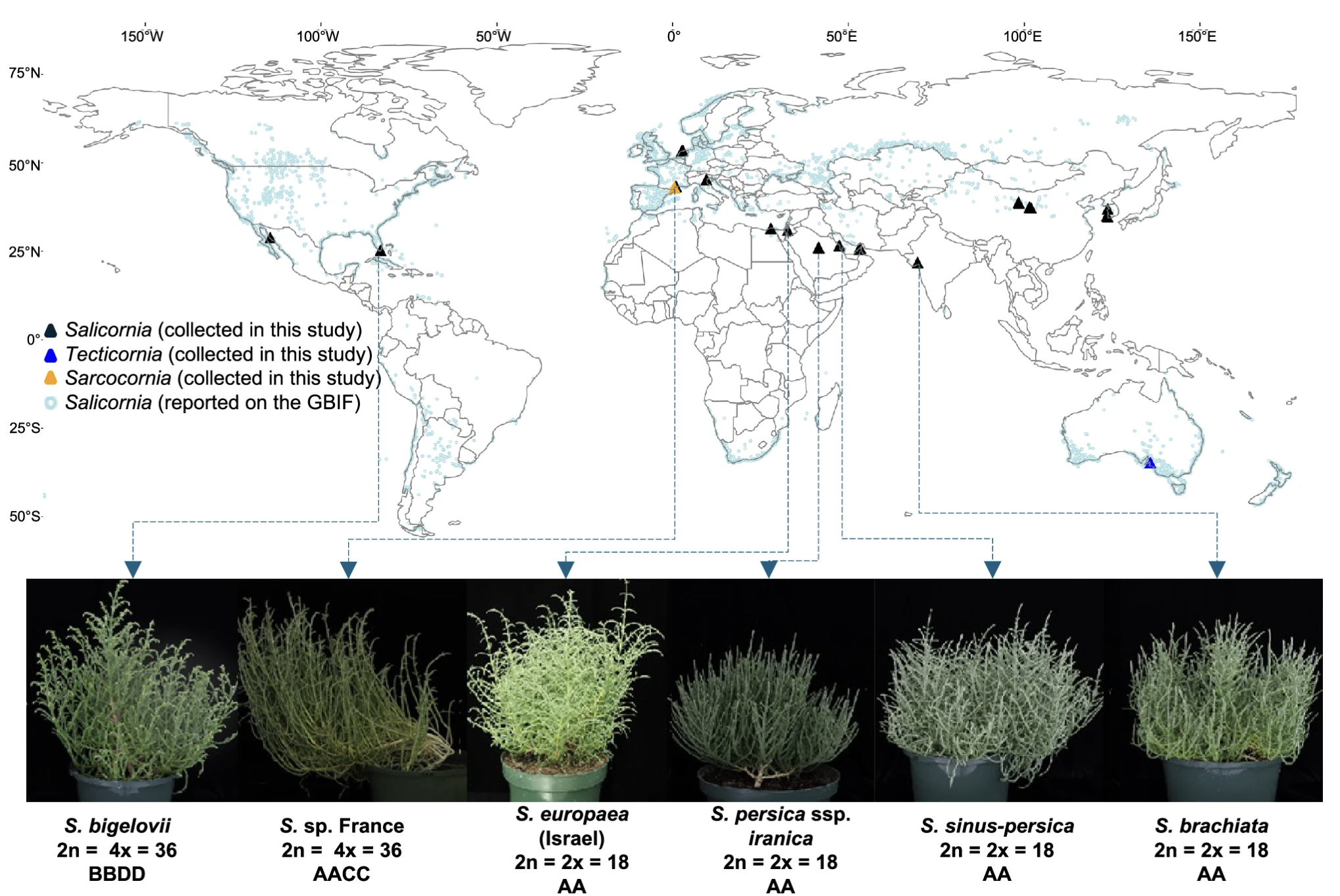
To address this, Yunchuan and the team built reference genomes for six Salicornia species and sequenced 318 wild and seed-bank plants collected from 13 countries. The result is a genomic map that researchers and breeders can finally use as a foundation for future work.
The study revealed four distinct subgenomes across the genus, including two tetraploid lineages that arose independently. One of these tetraploid genomes has nearly doubled in size through the expansion of retrotransposons, while the other has not. The team also showed that the French tetraploid is a distinct lineage carrying a subgenome not found in existing references.
Importantly for crop improvement, the researchers identified a candidate region for osmotic adaptation on chromosome 6A that contains a calcium channel gene, a strong target for future functional studies. To make the resource as useful as possible to the wider community, subgenome naming and chromosome numbering were aligned with existing references, allowing datasets to be compared directly.
This work was led and supervised by Vanessa Melino and Mark Tester. Laxman Adhikari, Ph.D., co-first author, led the population genomics analyses; Eva Hribova and her team contributed the cytogenetics; and Jesse Poland provided guidance throughout the project. We also extend our sincere thanks to all co-authors and collaborators around the world who collected germplasm and shared seeds to make this study possible.
Congratulations to Yunchuan and the entire team on this important contribution to plant genomics and saline agriculture.
📄 Read the full paper: https://lnkd.in/eWHm-a4Q
KAUST BESE | Plant Genomics | Halophytes | Saline Agriculture | Food Security